Health Management

Basic Policy on Health Management

One of the Group's basic policies is to "Build a safe and secure company and a rewarding and comfortable workplace.” We believe it is important for the Company's sustainable growth that employees can continue to work with good physical and mental health and vitality, which will lead to improved performance. To this end, we will actively promote health management aimed at improving the health of our employees.

Health Declaration

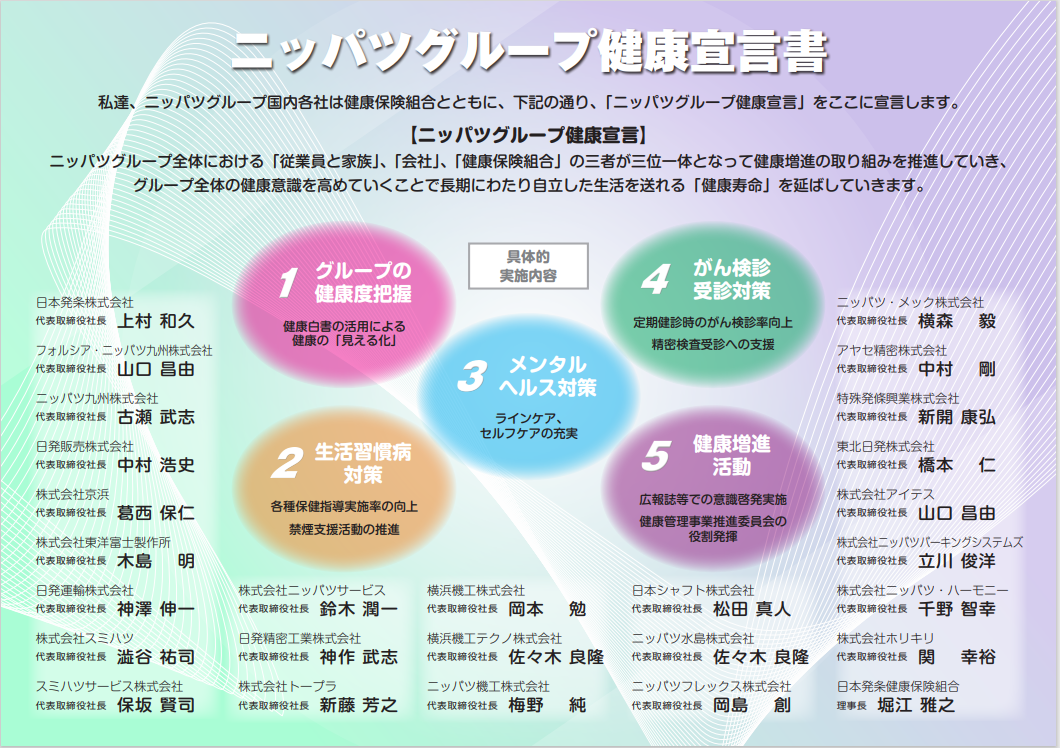
The NHK Spring Group Health Declaration has been jointly signed by the presidents of the Group companies to ensure that employees and their families, the companies, and health insurance associations work together to promote health improvement and raise health awareness throughout the entire NHK Spring Group.

Health Promotion System

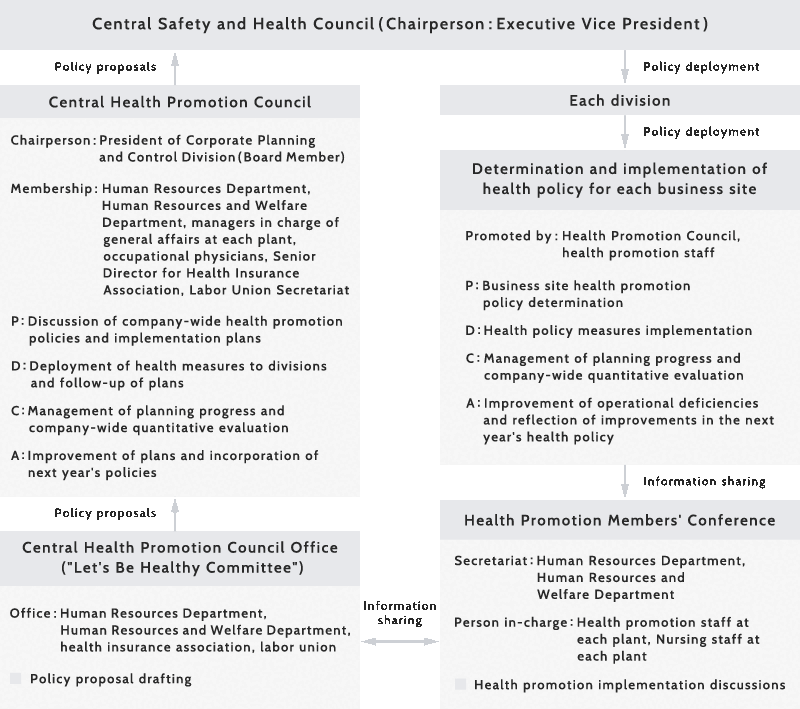
To promote health management on a systematic basis, we have established the Central Health Promotion Council, under the Central Safety and Health Council, the highest level organization, to formulate policy and implementation items and confirm implementation status of company-wide health measures. In addition, each business establishment has appointed health promotion committee members and health promotion staff to promote various health measures.

Organization chart of the Central Safety and Health Council

Health Management Strategy Map

Click the image to enlarge.
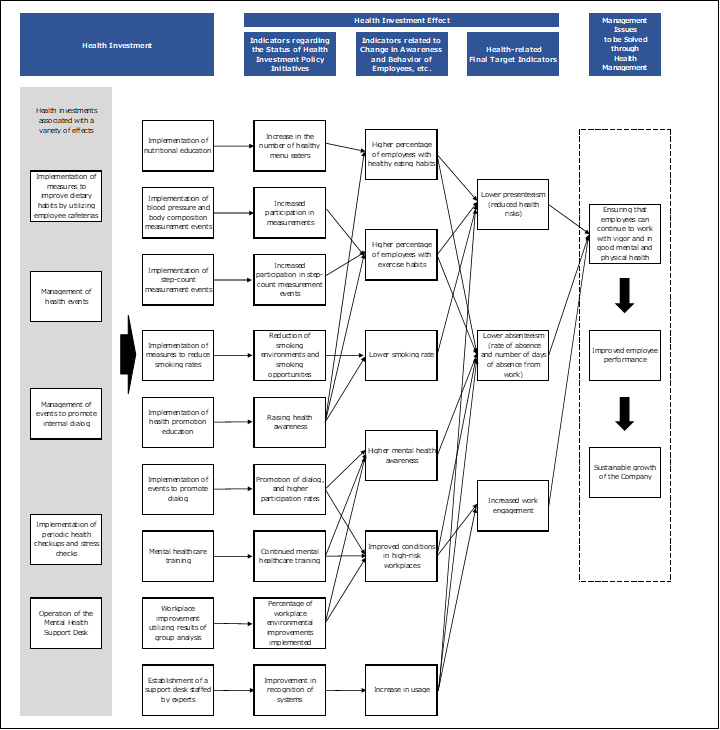
Health Management Strategy Map


Outstanding Organizations of KENKO Investment for Health

NHK Spring has been certified as a “2025 Outstanding Organization of KENKO Investment for Health (Large Enterprise Category)” for six consecutive years since 2020 under the “Recognition Program for the Outstanding Organizations of KENKO Investment for Health” established by the Ministry of Economy, Trade and Industry (METI).
This program is a system that recognizes corporations that practice particularly excellent health management based on their efforts to address local health issues and the promotion of health promoted by the Japan Health Council.
We believe it is important for the Company's sustainable growth that employees can continue to work with good physical and mental health and vitality, which will lead to improved performance. To this end, we will actively promote health management aimed at improving the health of our employees.
Health Management/Promotion Issues and Measures for Achieving Goals

Mental healthcare

We have set goals in the belief that we can improve productivity by lowering the rate and number of days of absence from work due to mental health issues, and thereby reducing absenteeism. In order to reduce the number of employees with mental health issues and shorten the length of absence from work, we must prevent mental health issues before they occur or detect them at an early stage. As measures to realize this, we believe it is important to improve workplace environment for alleviating high-risk workplaces based on the results of stress check group analysis, and to raise the awareness of employees through implementing mental healthcare training.

health_care
(1) Mental healthcare training

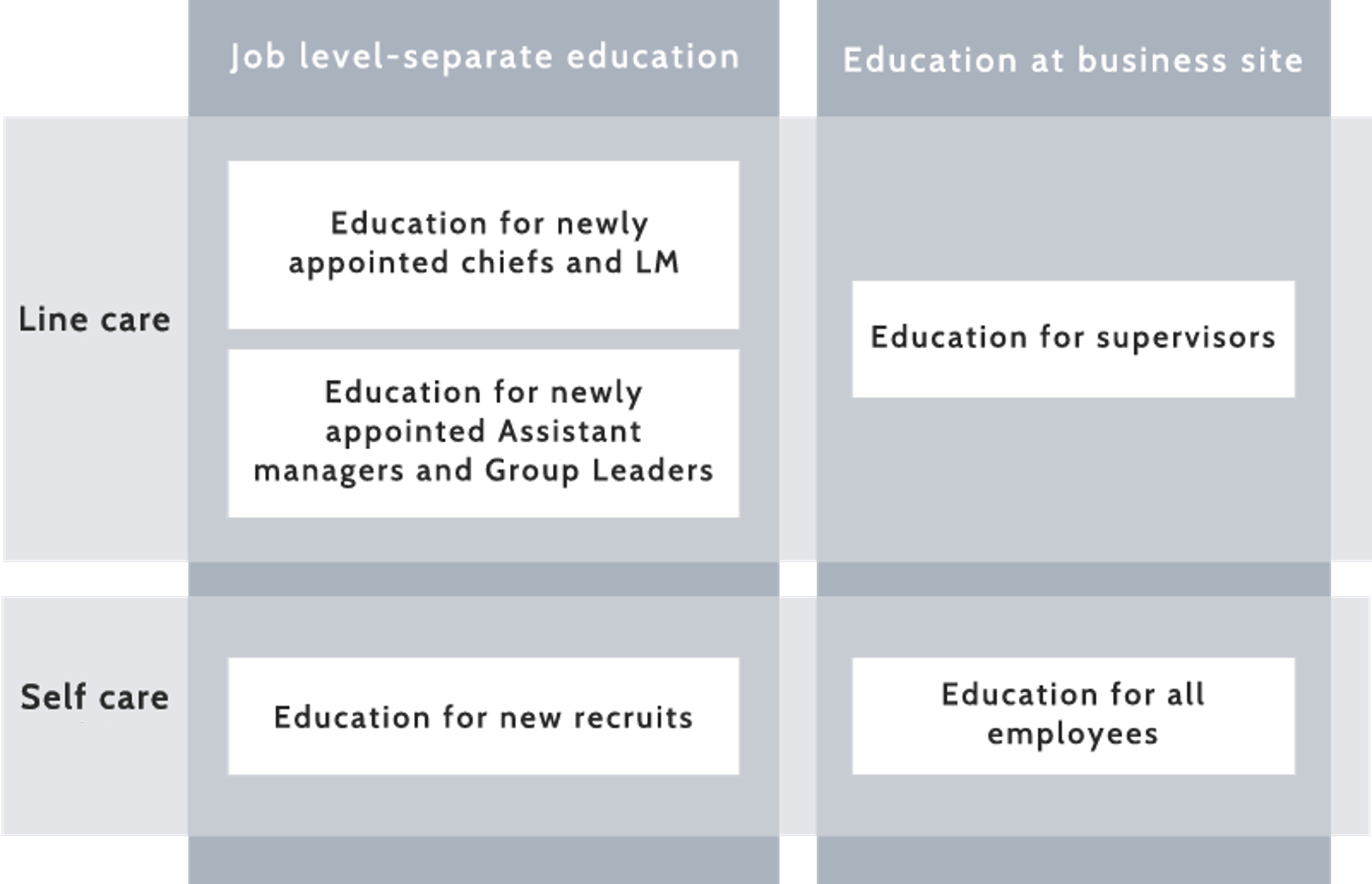
To enhance employee awareness and prevent mental health issues before they arise, we conduct job level-separate education when newly hiring and promoting employees, regular education at business sites for all employees, and e-learning-based training programs.
The line care training for managers, which was implemented in March-April 2024, was well received, with 565 participants showing a comprehension rate of 99.6% and 99.3% indicating that the training was effective in their practical work. This has contributed significantly to raising awareness of workplace improvement.

Education Programs Implemented in FY2024 Education at Business Sites
・Education for New Recruits (April 2024) 
・Line Care Training for Managers (April)
・Training for Newly Appointed Supervisors and  Newly Appointed Assistant Managers (May)
・Training for Mid-career Recruits (June and December)
・Training for Newly Appointed Managers (July)
・Training for Newly Appointed Group Leaders (September)
・Toyota Plant: Line Care Training (July)
・Yasu Plant: Self-Care Training (August)
・Ina Plant: Line Care Training (April), Self-Care Training (September-October)
・Komagane Plant (DDS): Line Care Training (June), Self-Care Training (October)
・Komagane Plant (Industrial Machinery & Equipment): Self-Care Training (November-December)
・Isehara Plant: Self-Care Training (November)
・Miyada Plant: Self-Care Training (March 2025) 


(2) Utilization of stress checks

① Workplace environment improvement
We implement workplace environment improvement in high-risk workplaces utilizing the results of stress check group analysis. 
As a result of implementing measures using the Workplace 

Implementing measures utilizing Workplace Environment Improvement Sheets in high-risk workplaces proved to be effective, with the average risk value of high-risk fifteen workplaces in FY2024 being reduced. 

② Individual follow-up
We provide 100% individual follow-up support for high-stress individuals who require assistance, conducted by healthcare professionals at each workplace, to enable early detection and prevention. We are actively working to reduce the number of high-stress individuals.

③ EAP utilization
We have contracted with an external EAP (Employee Assistance Program) provider and established a “Mental Health Support Desk” in October 2024. This service is available to support both our domestic and international employees, as well as their families.

Physical Healthcare

Concerning cases where employees take leave due to physical ailments, the leave-of-absence rate attributable to lifestyle-related diseases has remained unchanged, but the number of days of absence is on the rise. Accordingly, viewing the prevention and alleviation of lifestyle-related diseases as an issue, we have made reduction of leave due to lifestyle-related diseases a health improvement goal. 
Through improving employees' physical health, we hope to reduce absenteeism (absence rate and number of days absent) and improve conditions regarding presenteeism (reduction of health risks).  
To achieve our goals, we need to improve figures related to obesity, blood pressure, smoking habits and other causes of  lifestyle-related diseases.
As measures, we provide tools and stage events for improving health awareness and implement health improvement education concerning diet and so on.  

(1) Visualizing health promotion

We distribute fitness trackers to employees to raise awareness of physical activity opportunities, and we have adopted a health visualization program as a tool to promote the use of body fat monitors and blood pressure manometers installed at each business site. As a result, 37.1% of employees participated in the program. To help drive behavioral change among employees, we regularly hold events with the aim of establishing the habit of "measuring → understanding → becoming aware".

In FY2024, three health events, such as step-count measurement challenges, were held. The participation rate in these events was 53.8%, up 2.8% from the previous year, indicating a gradual rise in health awareness.
Furthermore, among users with a BMI of 25 or higher, there was a decrease in the average BMI compared to the previous year, suggesting the program has had a positive impact on health improvement.

(2) Dietary education - Healthy eating

To encourage employees to acquire dietary knowledge and the ability to make balanced food choices and practice healthy dietary habits, we implement health promotion activities in the employee cafeterias at each business establishment.
Specifically, we label the ingredients (calories, salt, carbohydrates, etc.) of food items on menus, indicate appropriate intake amounts, and provide healthy menus and seasonings with low salt and calorie content.

In FY2024, NHK Spring provided 6,420 healthy meals in all of its employee cafeterias.

(3) Review of smoking habits

In addition to offering encouragement and guidance to smokers on stopping smoking through the health offices at each business site, we continue to implement passive smoking prevention measures by designating at least one no-smoking day per month at each business site's smoking areas. In addition, we have introduced a smoking cessation support program to assist employees who wish to quit smoking.  The smoking rate has been declining year by year.

(4) Health checks and support

To reduce leave rates and days of leave resulting from lifestyle-related diseases, health offices at each business site conduct follow-up of employees who display symptoms and provide guidance on things like medical check-ups, re-examinations, and treatment.

(5) Health support for female employees

As part of our management policy initiatives to promote women's participation and career advancement, we are actively addressing health needs specific to women.
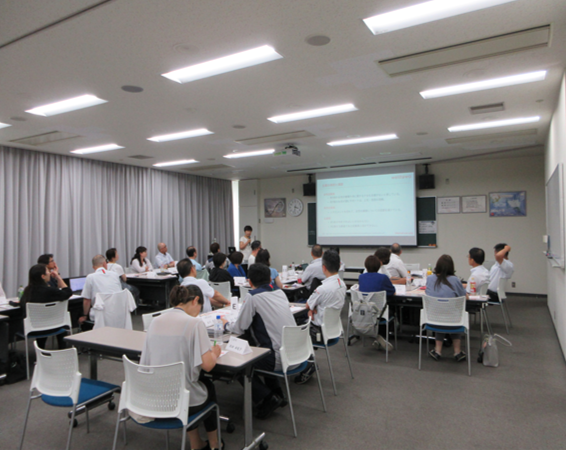
・At the Women’s Health Seminar “Menopause Edition” held in June 2024, 436 participants, including employees from five Group companies and their family members, attended the program and gave a high satisfaction rating of 4.14 out of 5.
・In September 2024, we established a “Consultation Desk for Gender-Specific Health Issues.” As of the end of March 2025, the service had been used 81 times and has been well received, as it provides a safe space to consult on sensitive issues as well as concerns related to children’s health.
・In January 2025, we conducted a “Menstrual Pain Simulation Session” for executive officers, followed by a “Menstrual Pain Simulation Workshop” for health promotion leaders and nursing staff in July. Approximately 80 participants experienced simulated menstrual pain. By fostering shared understanding of the challenges associated with menstrual pain, we are promoting a workplace culture of mutual support and inclusion.
seiri_workshop


Health Indicators and Numerical Goals

  FY2021 FY2022 FY2023 FY2024 Numerical Goal
Mental health leave rate (%) ※1 1.29 1.29 1.34  1.51  1.0
Mental health leave days (days/person) ※2 52 65 77  79  50
Physical health leave rate (%) ※1 0.90 0.68 0.77  0.7  0.8
Physical health leave days (days/person) ※2 33 48 46  58  30
Stress check participation rate (%)  97.7 98.7 99.1  98.5  100
Individual follow-up after stress check (%) 100.0 100.0 100.0  100  100
Smoking rate (%) 32.6 31.2 30.3  30.4  30
Annual health check-up participation rate (%) 100.0 100.0 100.0  100  100

Observation rate (%)

63.0 62.5 60.9  63.1 
Follow-up rate for those with observation findings (%) 100.0 100.0 93.0  99  100
Observation rate – Blood pressure (%) 11.4 11.2 11.7  11.7 
Observation rate – Liver function (%) 26.2 25.3 25.5  26.1 
Observation rate – Lipids (%) 33.3 33.2 33.2  33.2 
Observation rate – Blood sugar (%) 17.7 16.7 18.8  18.5 
BMI>25(%) 27.8 28.4 27.9  28.3 

※1:The proportion of the number of employees who took annual sick leave or medical leave due to mental or physical health issues, relative to the total number of employees.
※2:Average number of sick leave days per person, calculated by dividing the total sick leave and medical leave during the year (due to mental or physical health issues) by the total number of employees who took such leave.